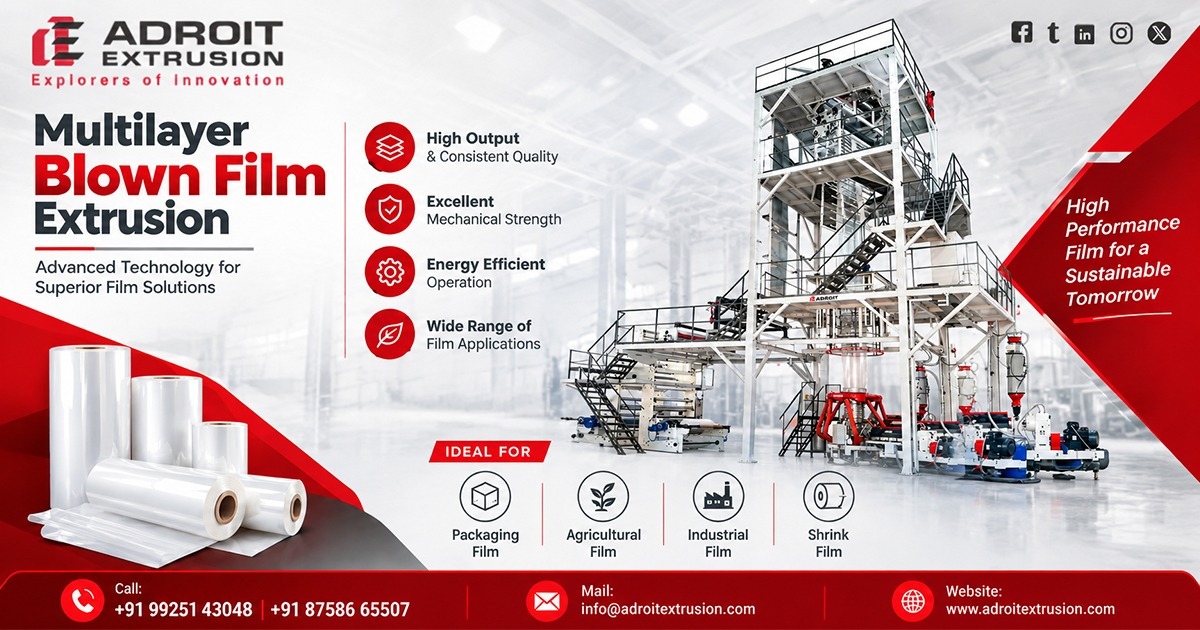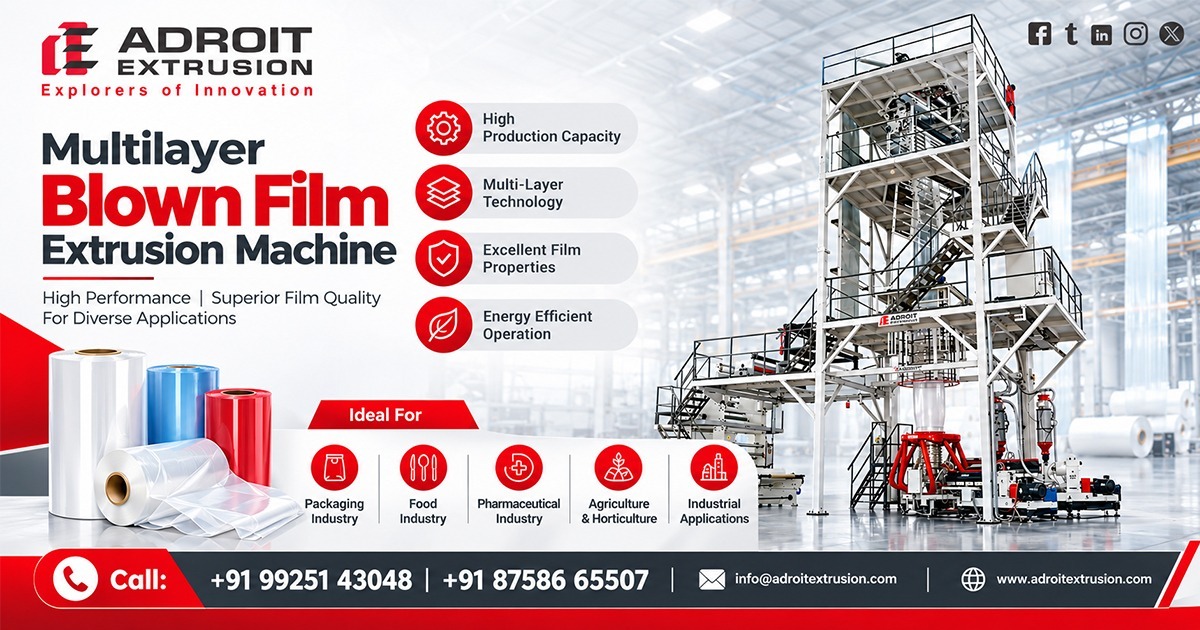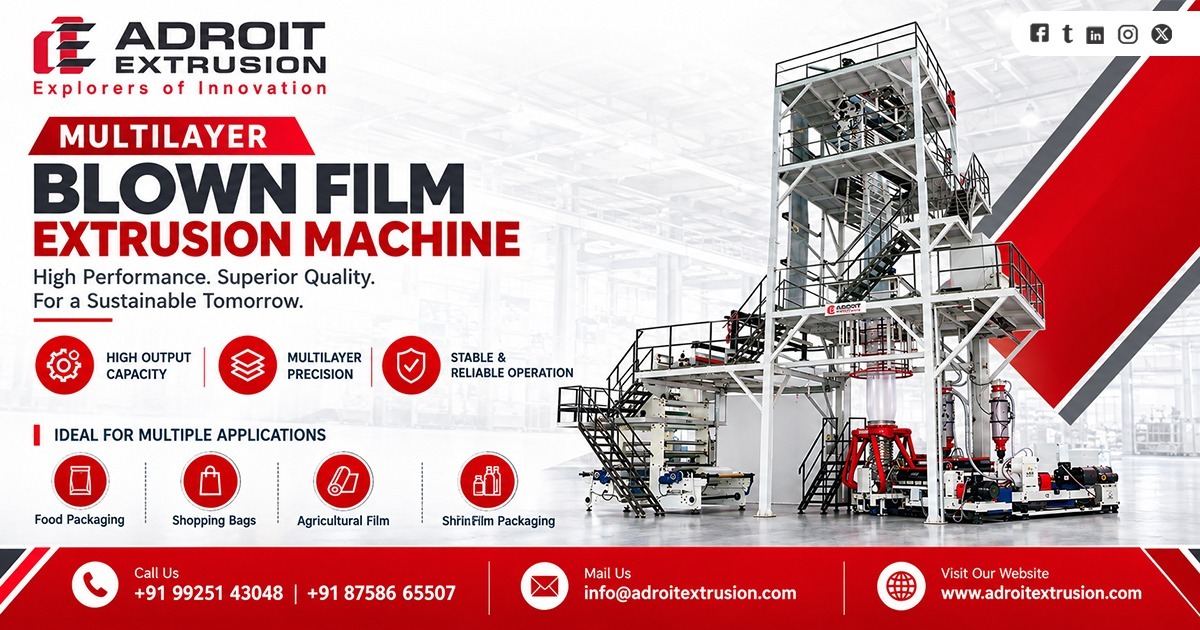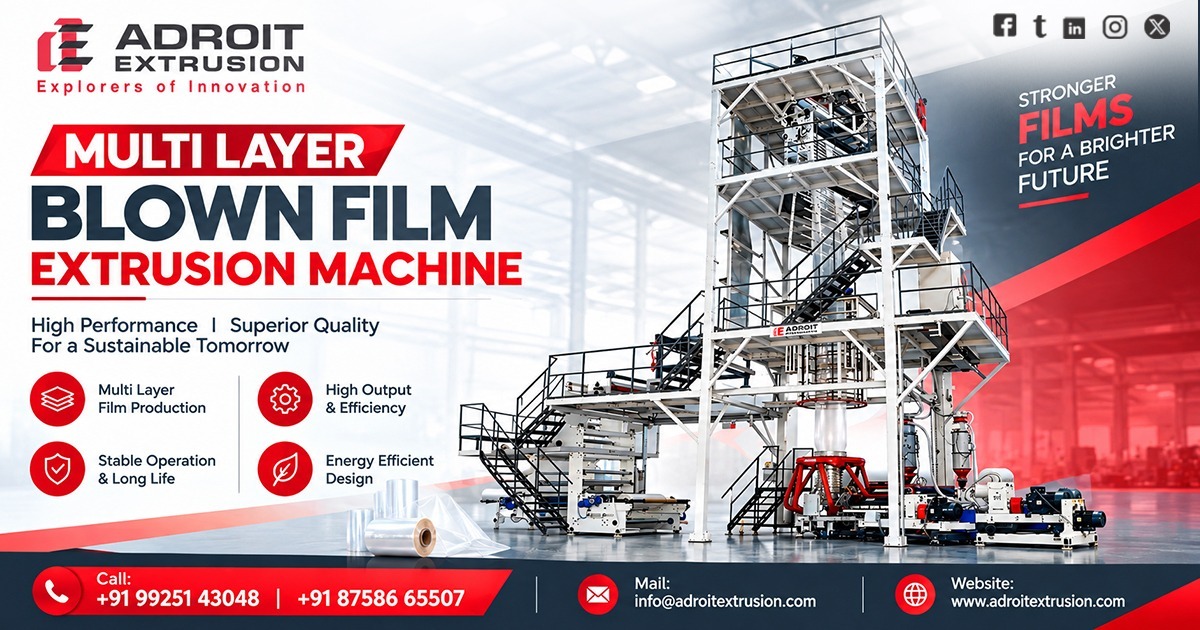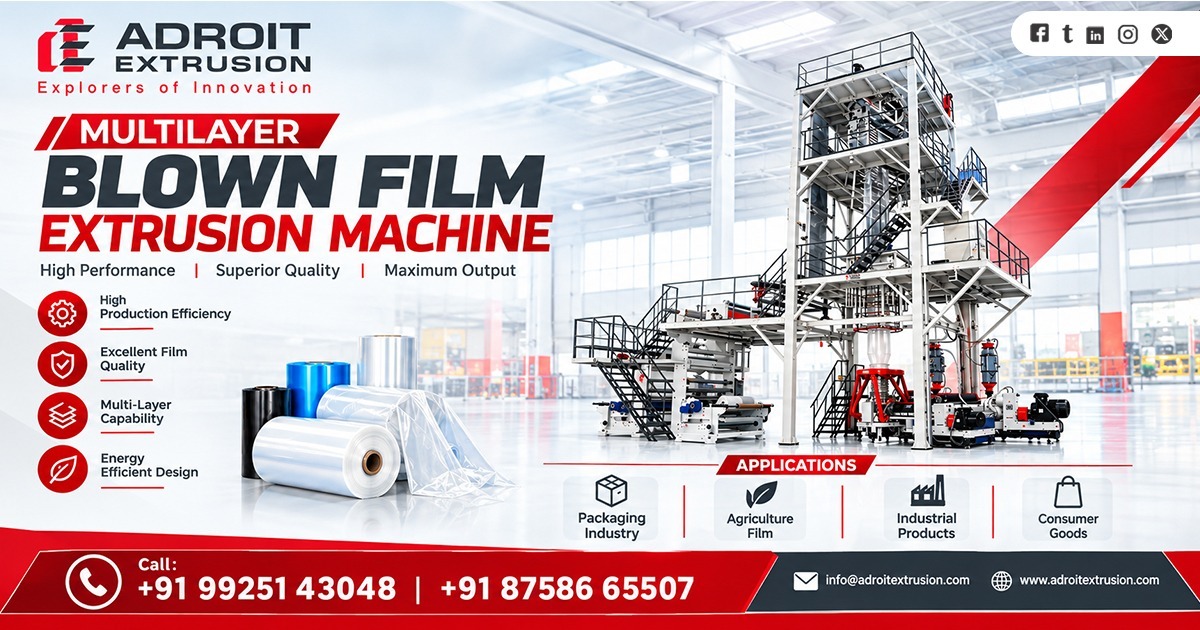
Adroit Extrusion helps manufacturers explore blown film extrusion solutions according to their production goals, packaging requirements, and desired film quality. Understanding the difference between 3 layer and 5 layer blown film machines enables buyers to choose suitable equipment based on material flexibility, investment, production efficiency, and end-product performance.
What Is a 3 Layer Blown Film Machine?
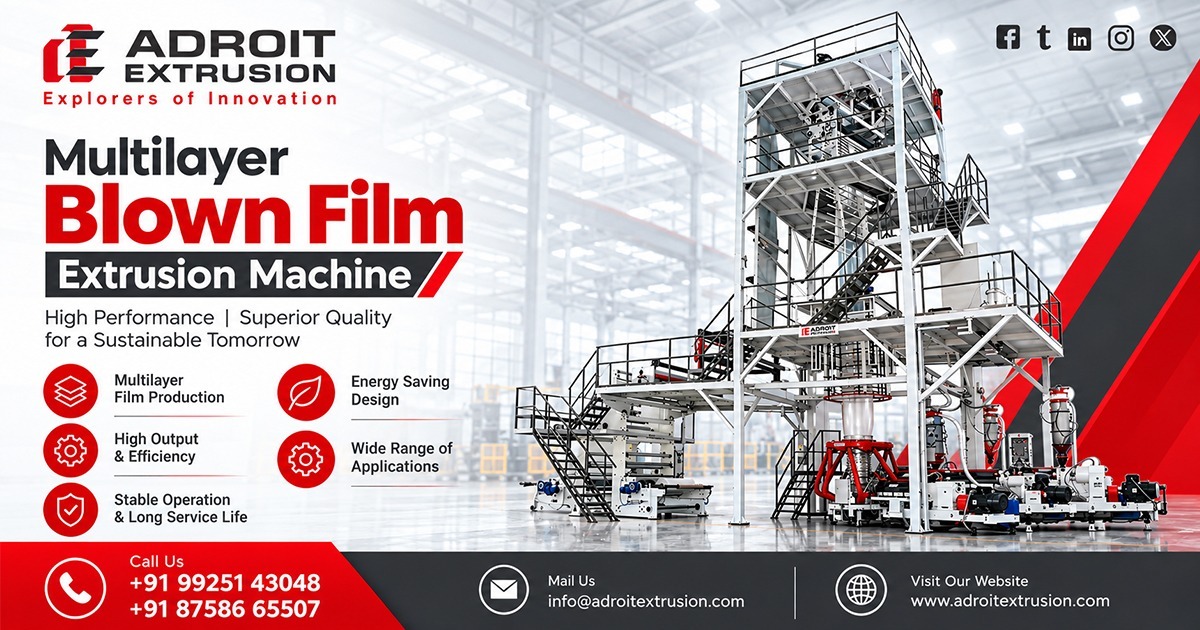
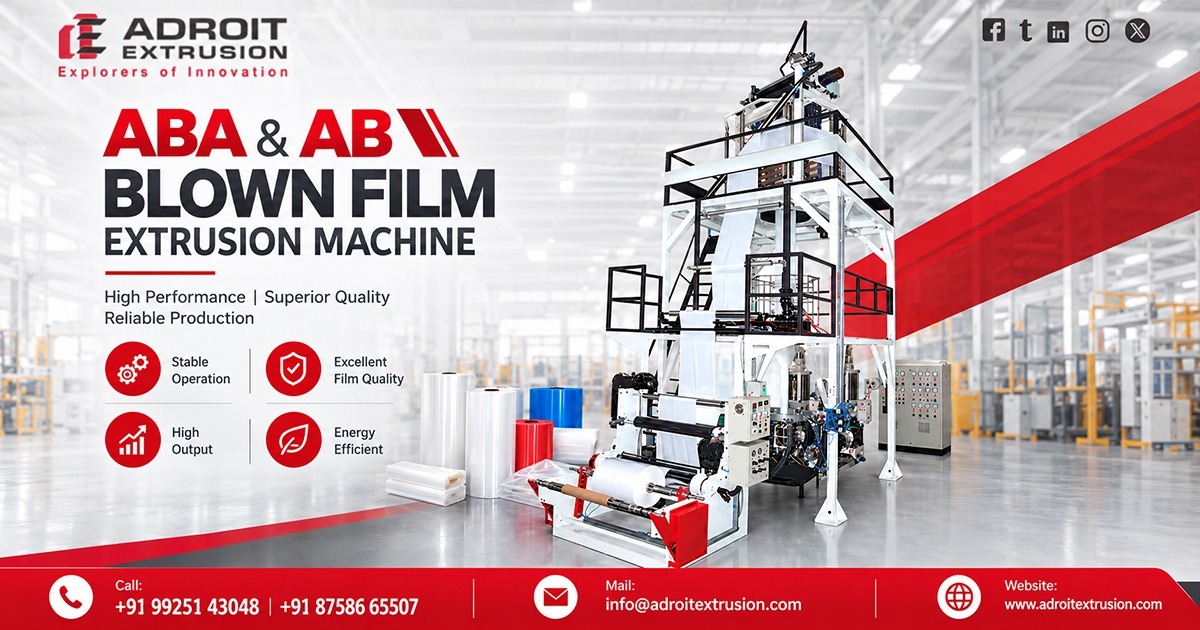
A 3 layer blown film machine is a plastic extrusion system designed to manufacture films with three distinct layers. Each layer can perform a specific function, such as improving strength, flexibility, sealing performance, or printability.
This technology allows manufacturers to combine compatible polymers and other suitable materials to produce films for different packaging applications.
Features of a 3 Layer Blown Film Machine
- Three-Layer Structure: Combines three polymer layers within a single film to achieve the required performance.
- Material Flexibility: Allows manufacturers to combine compatible polymers, recycled materials where suitable, and functional resins according to product specifications.
- Cost-Effective Production: Provides a practical balance between investment, material consumption, and film performance for many packaging applications.
- Production Efficiency: Supports consistent film manufacturing when correctly configured and operated.
- Versatile Applications: Suitable for shopping bags, carry bags, industrial liners, general-purpose packaging, and selected agricultural films, depending on machine configuration.
Benefits of a 3 Layer Blown Film Machine
- Requires a generally lower initial investment than many five-layer systems.
- Simplifies production planning for conventional packaging films.
- Enables efficient material distribution across three functional layers.
- Supports manufacturers entering multilayer film production or expanding existing production capacity.
- Offers relatively straightforward operation for standard film applications.
What Is a 5 Layer Blown Film Machine?
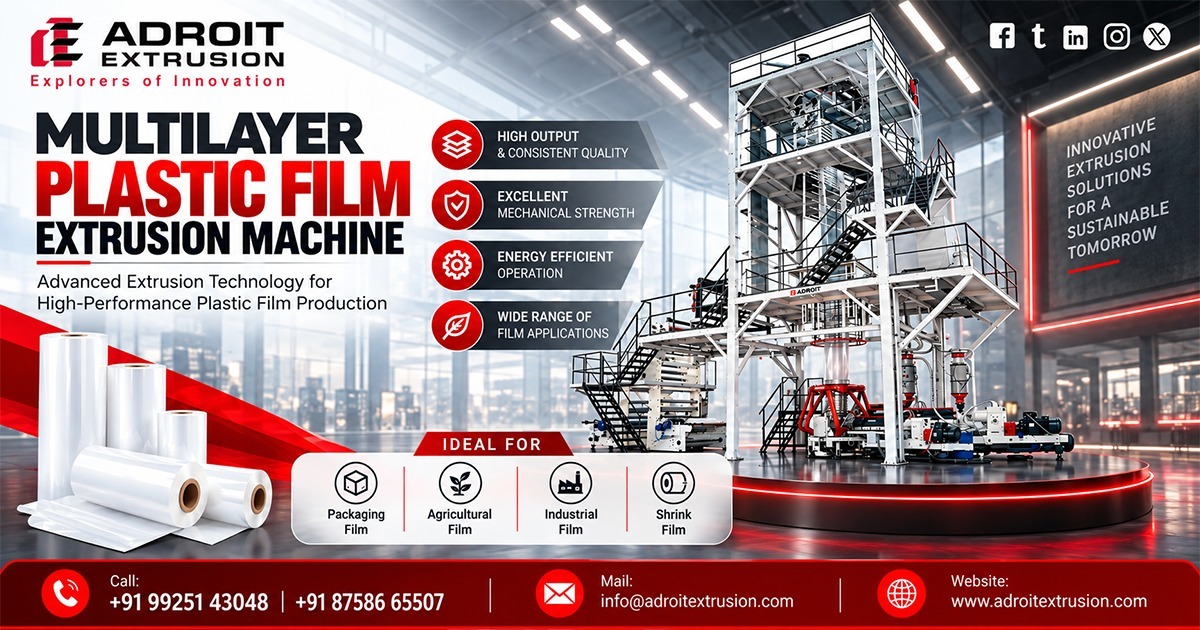
A 5 layer blown film machine is an advanced extrusion system that combines five polymer layers to manufacture films with specialised performance characteristics.
Each layer can be designed for a particular purpose, allowing manufacturers to develop complex film structures that balance mechanical strength, sealing performance, barrier properties, and material costs.
Features of a 5 Layer Blown Film Machine
- Five-Layer Structure: Combines five functional or complementary layers within a single film.
- Advanced Material Combinations: Supports complex combinations of polymers, tie layers, and barrier materials when compatible with the extrusion system.
- Enhanced Barrier Potential: Can incorporate materials such as EVOH or polyamide in suitable structures to improve oxygen or other gas barrier performance.
- Optimised Material Distribution: Allows expensive functional materials to be positioned in selected layers instead of being used throughout the entire film.
- Specialised Packaging Applications: Supports demanding packaging requirements where strength, sealing, barrier properties, and material efficiency must work together.
Benefits of a 5 Layer Blown Film Machine
- Provides greater flexibility in designing multilayer film structures.
- Offers opportunities to improve oxygen, moisture, or aroma protection, depending on the selected materials and layer arrangement.
- Helps optimise material costs through strategic layer allocation.
- Supports specialised food packaging, industrial packaging, and high-performance flexible films.
- Provides more options for balancing mechanical strength, sealability, printability, and barrier performance.
What Is the Difference Between 3 Layer and 5 Layer Blown Film Machines?
The primary difference is the number of layers available for distributing material properties throughout the film. A three-layer machine is suitable for many standard packaging applications, whereas a five-layer machine offers additional flexibility for more demanding film structures.
Comparison Between 3 Layer and 5 Layer Blown Film Machines
| Comparison Factor | 3 Layer Blown Film Machine | 5 Layer Blown Film Machine |
|---|---|---|
| Film Structure | Three layers | Five layers |
| Material Combinations | Suitable for common multilayer structures | Greater flexibility for complex material combinations |
| Barrier Performance | Depends on the selected polymers and structure | Can accommodate dedicated barrier and tie layers |
| Initial Investment | Generally lower | Generally higher |
| Process Complexity | Typically simpler | Typically more complex |
| Material Optimisation | Good flexibility across three layers | More opportunities to allocate materials by function |
| Maintenance Requirements | Depends on machine design and operating conditions | May require additional process controls and maintenance |
| Common Applications | Carry bags, liners, general packaging, and selected agricultural films | Barrier packaging, specialised food packaging, and industrial films |
| Best Suited For | Standard film requirements and cost-conscious production | Applications requiring multiple specialised film properties |
Applications of 3 Layer and 5 Layer Blown Film Machines
Both machine types serve the flexible packaging industry. The appropriate choice depends on the required film structure, raw materials, production volume, and performance specifications.
Applications of 3 Layer Blown Film Machines
- Shopping bags and carry bags
- Industrial liners and general-purpose packaging
- Agricultural films, subject to machine configuration
- Courier bags and flexible packaging films
- Packaging films requiring balanced mechanical strength and sealing properties
Applications of 5 Layer Blown Film Machines
- High-barrier food packaging
- Vacuum packaging and selected protective films
- Packaging for products sensitive to oxygen or aroma
- Industrial packaging requiring specialised material combinations
- Multilayer films designed for specific barrier, sealing, and mechanical requirements
How to Choose Between a 3 Layer and 5 Layer Blown Film Machine?
Selecting the right blown film extrusion machine requires evaluating both present production needs and future business opportunities.
Factors to Consider Before Buying
- Product Requirements: Identify the film thickness, width, strength, sealing properties, and barrier performance required for the final product.
- Raw Material Selection: Evaluate the polymers, recycled materials, additives, and barrier resins suitable for the intended film structure.
- Production Capacity: Match the machine’s output capacity with your production targets and expected customer demand.
- Investment Budget: Compare the initial equipment cost with operating expenses, material savings, and expected production requirements.
- Future Expansion: Consider whether your business may require specialised barrier films or more complex packaging structures in the future.
- Technical Support: Evaluate machine commissioning, operator training, spare parts availability, and after-sales support.
Frequently Asked Questions
Q1: What is the main difference between 3 layer and 5 layer blown film machines?
A 3 layer machine produces films with three layers, while a 5 layer machine provides two additional layers for greater material distribution flexibility and specialised film structures.
Q2: Is a 5 layer blown film machine better than a 3 layer machine?
Not always. A five-layer machine suits applications requiring complex material combinations or specialised barrier properties, while a three-layer machine efficiently meets many standard packaging requirements.
Q3: Which blown film machine is more economical?
A three-layer machine generally has a lower initial investment. Overall economics depend on production output, raw material costs, energy consumption, maintenance, and product requirements.
Q4: Can a 5 layer blown film machine produce barrier films?
Yes. With suitable barrier materials, such as EVOH or polyamide, and compatible tie layers where required, a five-layer machine can manufacture films designed for enhanced barrier performance.
Q5: Which applications are suitable for a 3 layer blown film machine?
Common applications include carry bags, industrial liners, general-purpose packaging, and selected agricultural films, depending on the machine configuration and material specifications.
Q6: What should buyers consider before selecting a blown film machine?
Buyers should evaluate film specifications, material compatibility, production capacity, investment budget, operating costs, and future packaging requirements.
3 Layer and 5 Layer Blown Film Machine Supplier in India
Adroit Extrusion supplies 3 layer and 5 layer blown film machines in India, serving manufacturers and packaging businesses across multiple industrial regions.
Our service coverage includes the following states and union territories:
Andhra Pradesh, Arunachal Pradesh, Assam, Bihar, Chandigarh, Chhattisgarh, Dadra and Nagar Haveli and Daman and Diu, Delhi, Goa, Gujarat, Haryana, Himachal Pradesh, Jammu and Kashmir, Jharkhand, Karnataka, Kerala, Ladakh, Madhya Pradesh, Maharashtra, Manipur, Meghalaya, Nagaland, Odisha, Puducherry, Punjab, Rajasthan, Sikkim, Tamil Nadu, Telangana, Tripura, Uttar Pradesh, Uttarakhand, and West Bengal.
Contact Adroit Extrusion
Contact Adroit Extrusion today to explore suitable blown film extrusion solutions for your production goals, packaging applications, and business growth.
Website: www.adroitextrusion.com
Email: info@adroitextrusion.com
Phone: 09925143048 | 08758665507
View Product: Click here